
Changemaker Catalyst Award recipient, Chidinma Umahi Odi Nwankwo attended the Global Human Rights Certificate Program by University of Pennsylvania Carey Law School Global Institute for Human rights virtually from June 8 to June 19th 2020. Chidinma is an LLM Student, Class of 2020, Majoring in International and Comparative Law.
June 8 marked the beginning of a Virtual Global debate on human rights in the 21st century at the Global Human Rights Institute, University of Pennsylvania Law School. The two weeks discourse had in attendance over 100 young leaders from across the world and more than 30 distinguished renounced human rights scholars/ advocates. The theme for this years’ engagement is titled Building a new generation of Human Rights advocates. Considering that human rights are imperative for the protection and promotion of the human rights of all persons globally, the goals of the institute are of three folds:
- To introduce students to a rigorous study of human rights theory;
- To explore current and pressing human rights issues;
- To expose future proponents of human rights to the ways that human rights advocacy might interact with their career, aspirations whether in law, policy, or other fields.
June 8 marked the beginning of a Virtual Global debate on human rights in the 21st century at the Global Human Rights Institute, University of Pennsylvania Law School. The two weeks discourse had in attendance over 100 young leaders from across the world and more than 30 distinguished renounced human rights scholars/ advocates. The theme for this years’ engagement is titled Building a new generation of Human Rights advocates. Considering that human rights are imperative for the protection and promotion of the human rights of all persons globally, the goals of the institute are of three folds.
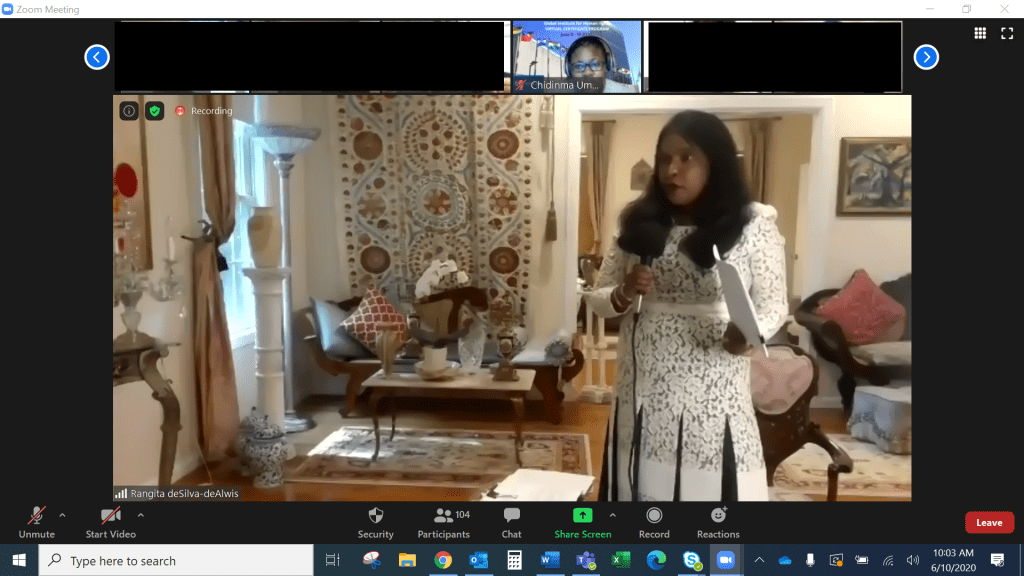
Prof. Rangita de Silva de Alwis delivering the open speech to all participants
Since its inception, the center has been dedicated to the legacy and leadership of Nelson Mandela. Remarkably, 2020 marks the 20th anniversary for the Women, Peace, and Security agenda, a decade of action towards the sustainable development goals, the 75th anniversary of the United Nations, the 25th anniversary of the 4th world conference on Women, and the adoption of the Beijing Declaration and Platform for Action. However, with the challenges associated with the Covid-19 pandemic and the fight for racial discrimination initiated the discussion was focused on: Great Debates on Human Rights in the 21st Century in a Time of Covid-19.
In his Keynote speech in the second week, His Excellency, Ambassador Matthew Numetz focused on his role as a United Nations representative for the renaming dispute between Greece and the Republic of North Macedonia. He has dedicated 24 years towards finding a peaceful and sustainable solution to the problem. In his speech, he highlighted four solutions: –
- Use of names and words count – the use of names is important and has its implications.
- Process- It is important to have an important process as a human rights advocate. The process must respect the people.
- The idea of timing- Not everything can be solved at a time. Keep the relationship going, build trust in the process and wait for the right time
- The willingness of the people to accept the compromise. Remember that name is about heritage and identity.
Although I wished the events were in-person, the organizers were able to produce an innovative engagement by adopting the use of storytelling and design thinking as a tool to solve some of the complex social problems discussed in class. The course schedule was divided into twenty-five modules that examined the intersection of human rights and other broad areas using the different treaties, laws, and stories of practitioners in the field. On the final day of the engagement, my group (Group 4) presented on the representative of the United Nations a Policy Memo: Human Rights Legal Education for Girls/Women. Our policy Memo was focused on The aim of the policy report is to illustrate the need for promoting the human right of women and girls and to create awareness about the existence of such rights. An Attempt will be made to examine the legal provisions of some nationals law, international treaties, and various conventions.
 CHIDINMA UMAHI NWANKWO
Leave a comment