
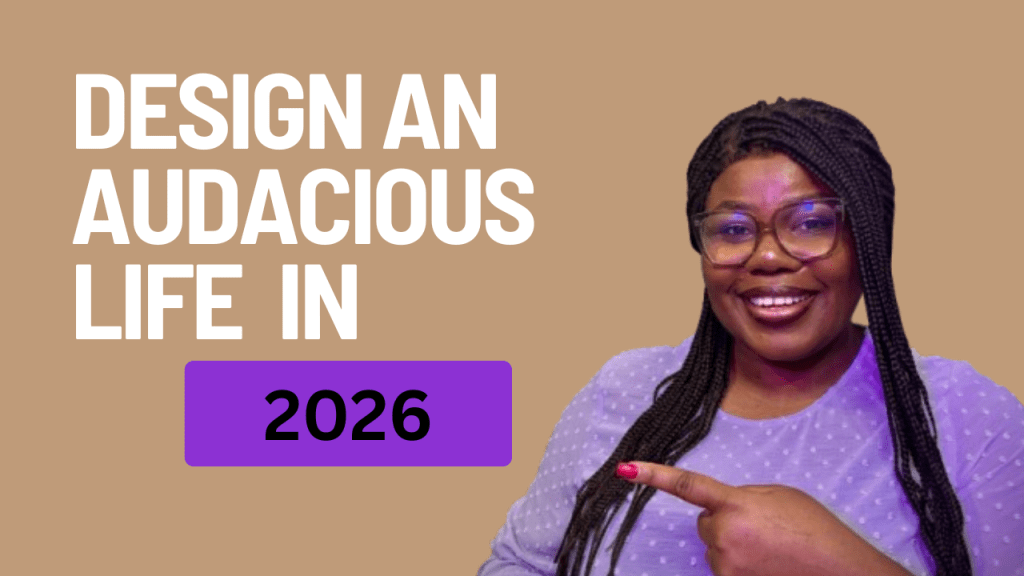
Welcome to 2026.
A new year filled with twelve months and fifty-two weeks each one offering a fresh opportunity to grow, realign, and become more intentional about the life you are building.
As the year begins, I’ve been reflecting deeply on where I am and where I’m going. I recently completed an exercise that helped me pause and take stock. An exercise focused on rebranding and redesigning my life which started out in 2017 for me. I want to share it here, not as an expert, but as someone actively in the process of evolution.
Additionally this foundation questions has been especially important for me in my 30s, a season where life has expanded, shifted, and demanded more intentionality. Over the years, I’ve experienced significant professional and personal transitions, and I’ve noticed that after every birthday, there’s an increasing need to realign my life with what truly matters.
This piece is about the questions that helped me get started.
Why This Reflection Matters
By training, I’m a lawyer. But beyond my formal education, my life has been shaped by various transitions including writing some professional exams towards re-qualifying as a lawyer in Canada, navigating different career pivots, learning how to rebuild as a new immigrant in two countries, and now intentionally working toward becoming a thought leader in my field.
These experiences taught me that growth is not accidental. Reinvention is not a one-time event. It is an act of evolution, one that requires intention, honesty, and the right systems.
Learning how to adapt and make change is a skill. And like any skill, it can be practiced, refined, and revisited as many times as needed with the right systems and structure.
The Questions That Guide Reinvention
1. Who are you?
This question sounds simple, but it is not. Answering it requires clarity about your values, mission, and commitments. It asks you to look beyond titles, roles, and external expectations, and instead understand who you are at your core.
2. What is your why?
Why do you want to reinvent or redesign your life?
I like to think of this as a factory reset, not to erase where you are, but to intentionally upgrade where you are going. This question invites you to focus less on your current circumstances and more on the future you are buidling.
3. What are your fears, obstacles, and challenges?
Growth is rarely comfortable. Not every step forward will feel safe or familiar. Many times, progress requires courage, doing things afraid. I once heard Hayet Rida say that “failure is research,” and that idea has stayed with me.
Even successful people experience fear. The difference is not the absence of fear, but the refusal to give up. And honestly, if what you are working on does not scare you a little, it may not be audacious enough.
4. Your mindset
Do you have a growth mindset? One that sees opportunity, abundance, and possibility every time you try something new?
A fixed mindset focuses on limitations and fear of failure. A growth mindset embraces effort, learning, and progress. Every attempt becomes data and every experience becomes feedback.
5. How much time are you willing to commit?
This question deserves its own conversation, and I will explore it more deeply later this year. But before committing time to anything new, it is important to conduct a time audit, an honest look at how you currently spend your days. Only then can you identify pockets of time to intentionally invest in your growth.
The goal isn’t perfection but making progress daily – Becoming one percent better.
6. What sacrifices are you willing to make?
Every meaningful transformation requires trade-offs and sacrifices.
This looks different for everyone, but growth often asks us to let go of comfort, convenience, or familiarity in exchange for alignment.
7. Who is doing something similar that you can learn from?
It an be an institution or an individual. This is not about comparison or imitation.
It is about seeing what is possible and learning from others as you begin to create systems and strategies that work for you.
8. What systems will hold you accountable?
Motivation fades. Systems sustain. As the CEO of your life, itis not enough to set the vision, you must also design the systems that make it achievable.
Ask yourself:
- What structures will support my goals?
- How will I track my progress?
- Who or what will help keep me accountable?
9. What does success mean to you?
Success is personal. And it evolves with seasons of life.
If you do not define success for yourself, you may spend years chasing someone else’s definition and still feel unfulfilled.
A Final Reflection
I encourage you to intentionally set aside time to work through these questions. I spent four to five hours on this exercise and treated it as a personal date with myself, amoment of honesty, reflection, and vision-setting.
Remember that this is about your 360 life. As you reflect, consider what self-care, wellness, rest, family, and relationships mean to you. No area of your life should be overlooked.
And above all, remember to bet on yourself.
Reinvention begins with that decision.
 CHIDINMA UMAHI NWANKWO
Leave a comment