
Overview
This page features a curated selection of my writing, research, and professional contributions across law, human rights, health policy, and emerging technology.
It includes my original work, commentary, and selected engagements including guest lectures and reflections on industry reports that contribute to broader knowledge, inform policy conversations, and practice.

Tracing Sexual Violence in Conflict as a Continuum of Violence Against Women and Girls in Northern Nigeria: Pitfalls of Law and Policies
Sexual violence is a human rights infringement that causes harm in the lives of individuals when committed and may lead to severe complications, disabilities or even death. In Nigeria, women suffer from a chain of violence which is traced from regular times to post-conflict situations in addition to other social problems like gender discrimination, gender inequality, to name but a few. As a result, this work focuses on the experiences of Nigerian women with sexual violence in conflict and post-conflict settings in Northern Nigeria, especially with the abductions of girls in Borno and Yobe States between 2014 and 2018. This research approaches the problem through desk research using the socio-legal methodology, which draws insights from the interdisciplinary lens of human rights law, international security, and women/development using post-colonial feminist theory. The primary question this work poses is how the Nigerian National Action Plans (NAP) on Women, Peace and Security (WPS) can be utilized to help end the conflict-related sexual violence continuum in Nigeria and advance the protection of women against sexual violence? The research finds that there are insufficient policy guidelines and legal frameworks for the prevention or eradication of sexual violence in Nigeria, and where policy guidelines or frameworks exist, there has been poor or no implementation.

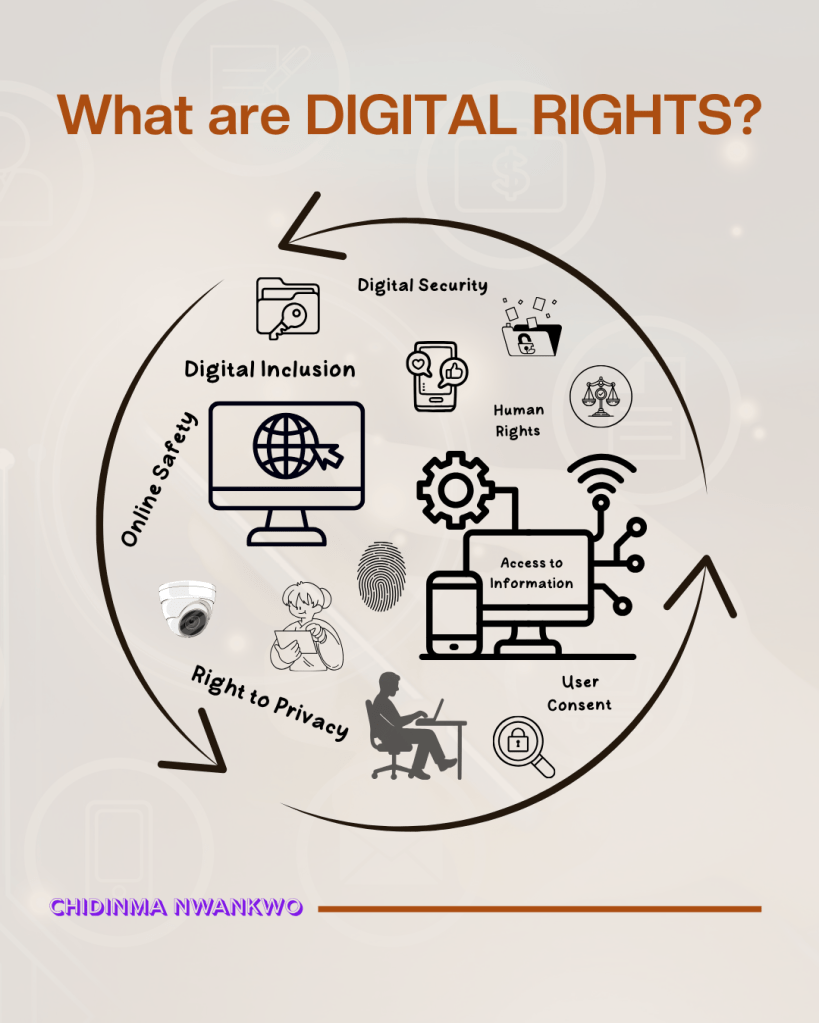
DIgital rights
Digital Rights as Human Rights
AI AND HUMAN RIGHTS – AN INTRODUCTION
Coming soon
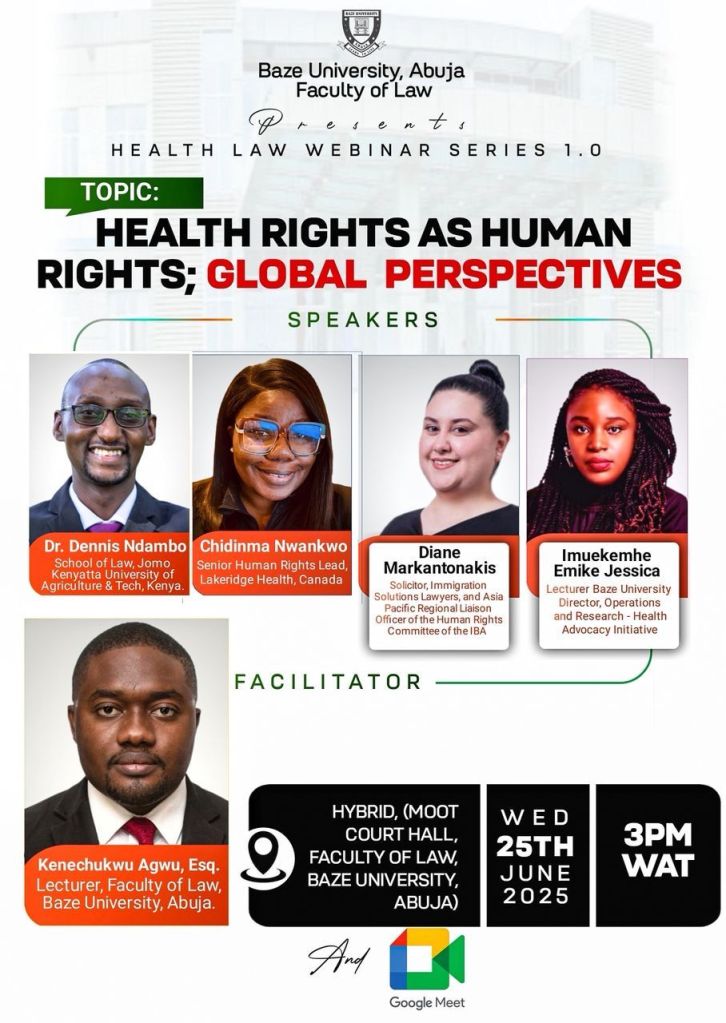
Guest Lecture – Health Rights as Human Rights
I am grateful to Sunday Kenechukwu Agwu for the kind invitation to speak with his students on Health Rights as Human Rights from a Canadian perspective. It was my absolute pleasure to present alongside Diane Markantonakis, Dennis Mutua Ndambo, and Emike Jessica Imuekemhe LLB, LLM, MSc, MCIArb(UK), AICMC.
As highlighted during the session, health rights as human rights is a vital framework that underscores the interdependence and interconnectedness of the right to health with all other human rights. Grounded in dignity, equity, and justice, it ensures legal accountability, promotes fairness, and upholds non-discrimination in the delivery of health services.
My presentation focused on the regulatory laws that protect the right to health in Canada, the practical application of international and national laws, and the ways in which the right to health interconnects with other fundamental human rights.
I concluded by emphasizing the continued need to adopt a human rights-based approach in health policy, processes, and programs to achieve better, more inclusive, and equitable health outcomes for all.
A copy of the presentation summary can be found here.
2025 Nigerian Legal Industry Report: Reflections
Earlier this year, Strictly Law Business (SLB) released a report titled “2025 Nigerian Legal Industry Report: Highlights and 2026 Outlook.” It offers a timely and insightful reflection on a Nigerian legal market that is not only evolving, but being actively reshaped by economic pressures, regulatory reform, and technological acceleration across sectors.
The report is notably comprehensive. It examines the state of the legal market in 2025, key legal and regulatory developments, the changing nature of legal demand, and how law firms are repositioning strategically. It also looks ahead to 2026, identifying growth areas across different sectors, including finance and fintech, ICT and digital services, tax, regulatory compliance, emerging technology, AI governance, and the creative industries.
What stands out most is how clearly the report captures a shift many practitioners are already experiencing, the evolving role of the lawyer. Specifically, organisations and clients are no longer engaging lawyers solely for traditional legal work. Increasingly, lawyers are expected to act as strategic partners and advisors, supporting clients to navigate uncertainty, manage regulatory exposure, and make legally sound decisions in complex and fast-moving work environments.
As organisations are held to higher standards, the expectation is no longer just to comply, but to demonstrate accountability in practice. This evolution is not surprising. Equally significant, as captured in the report, is the continued expansion of Nigeria’s digital economy. Growth in fintech, e-commerce, data-driven services, AI, and emerging technologies has introduced new layers of legal complexity. Legal work in this space is becoming more specialised, requiring not only strong technical knowledge but also a practical understanding of how digital business models operate. This becomes even more critical as issues such as artificial intelligence and cross-border data flows begin to shape regulatory priorities.
The report also reinforces the importance of sector-specific expertise. For lawyers, this signals a need to move beyond general practice and develop deeper, more targeted expertise that aligns with where the market is heading. Ultimately, the report is a reminder that the legal profession does not operate in isolation. It is shaped by the economic and regulatory systems within which it exists. For lawyers, this moment calls for adaptability, continuous learning, and a willingness to engage with the broader issues influencing legal practice.
I also want to say a big thank you to the mastermind behind SLB and this report, Olubusola Ajala – the Brave and the editors Faith Obafemi, David Padonu, for delivering such a timely and comprehensive piece. Reports like this are essential in informing how lawyers and law firms think, operate, and position themselves strategically.
Technology-Facilitated Violence Against Women in the Workplace

Trauma informed approaches to Investigations and Lawyering
Investigations Report – Content and importance
Coming soon
 CHIDINMA UMAHI NWANKWO